
Rent Collection With Mada, Apple Pay and STC Pay: A Saudi Landlord Playbook
Give tenants the payment methods they already use, then automate the reminder, confirmation, invoice and landlord update behind them.
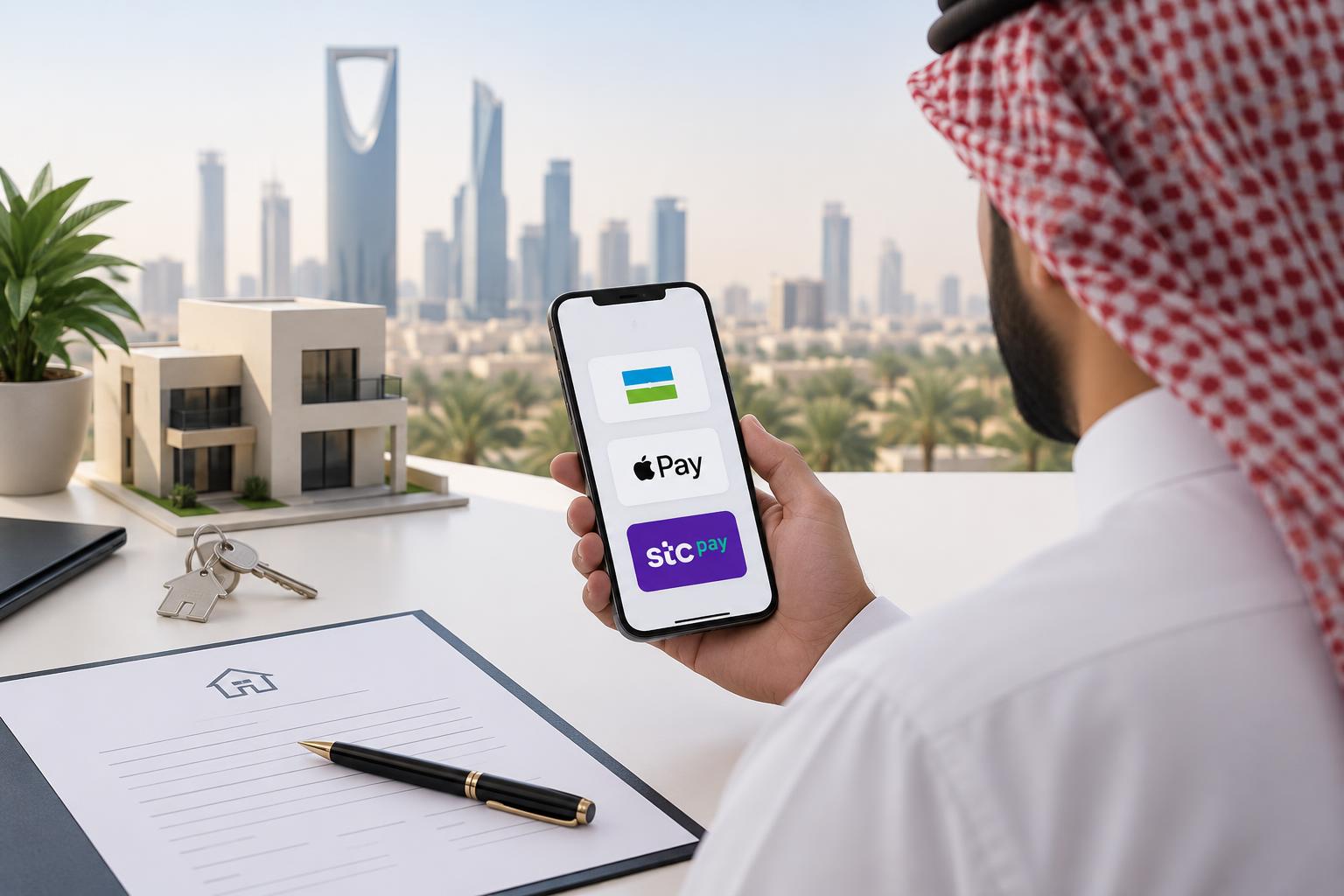
Rent collection gets easier when a tenant can pay in the same WhatsApp thread where the reminder arrived. Mada, Apple Pay and STC Pay each remove a little friction: no branch visit, no typing IBAN details, no waiting for a receipt to be checked by hand.
But a payment method is not a collection system. You still need the right amount, the right lease, a confirmed transaction, a compliant invoice and a landlord update. Maktabi connects those steps for Saudi property teams. Here is a practical way to use Mada, Apple Pay and STC Pay without creating more manual work.
Make the payment path obvious
The best tenant experience is boring: one link, one amount, one due date, one confirmation. A payment link tied to a specific rent cycle does that. The tenant sees what they owe, pays from their phone and gets a receipt. Your team sees the cycle close instead of hunting through chat history.
Maktabi's payment flow follows that pattern: connect a licensed gateway, create a link for a tenant, let the tenant choose an approved method, receive the gateway confirmation, mark the rent cycle paid, pause pending reminders and issue the invoice. The value is not the checkout page alone. It is everything that happens after the tenant taps pay.
Where Mada, Apple Pay and STC Pay fit
For Saudi Arabia, Maktabi's payments page lists Mada, Apple Pay and STC Pay alongside Visa, Mastercard, Amex and Google Pay. Availability depends on the country and the configuration of your gateway account; Maktabi says it offers only the methods approved for your country.
Use the methods to match tenant preferences, not to create separate processes:
- Mada gives tenants a local Saudi card option.
- Apple Pay gives tenants on supported Apple devices a fast mobile checkout.
- STC Pay gives wallet users a phone-based option.
The right combination is the one your gateway supports and your tenants actually use. Keep the payment link open to multiple methods, then review which ones tenants choose. Do not force every tenant into one wallet.
Start with a SAMA-licensed gateway
For Saudi landlords and property teams, online rent collection should run through a payment gateway licensed by the Saudi Central Bank (SAMA). Maktabi integrates with gateways licensed by the central monetary authority in each GCC country. You open the merchant account, enter your API keys in Maktabi, choose test or live mode and select the local methods you want to offer.
The money stays in your gateway account. Maktabi states that it does not hold funds, take a platform cut or add a layer between your agency and your money; fees are between you and your gateway. That is the right structure to ask about. Before go-live, confirm settlement timing, refund rules, chargeback handling and transaction fees directly with your provider.
Run one sequence from due date to receipt
- Connect the gateway. Add your credentials, enable the approved methods and start in test mode.
- Create the rent cycle. Make sure the lease, tenant, unit, amount and due date are correct before a link is sent.
- Generate a payment link. Set the amount, description and optional due date. Send it in the WhatsApp reminder.
- Automate the follow-up. Maktabi's collection workflow describes four reminder types: before the due date, on the due-date morning, after the due date, and a landlord transfer notice. Timing is configurable.
- Close the loop. On confirmation, Maktabi marks the rent cycle paid, pauses pending reminders, generates a ZATCA Phase 2 compliant invoice and syncs it to Zoho Books.
Keep bank transfers in the same workflow
Some tenants will still transfer from their bank and send a screenshot. Treat that as a first-class payment path, not an exception that lives in someone's phone.
Maktabi's collection workflow uses AI to classify tenant replies into payment confirmation, payment promise, extension request, dispute or bank-details request. When a tenant sends a receipt image, OpenAI Vision extracts the amount, date and reference, then matches it to the open rent cycle. Your team gets the result instead of manually reading every screenshot.
Set rules for partial payments, mismatched amounts and disputes. Automation should route exceptions to a named person with a deadline.
Give landlords proof, not promises
Landlords judge collection by what reaches their account and what they can see. Maktabi's landlord portal shows portfolio income, payments, statements and maintenance approvals in Arabic. After the management fee is deducted, the system sends a WhatsApp transfer notification with the net amount, unit and payment period.
Agencies can also generate a ZATCA-compliant statement per landlord, email it and export a CSV. For a landlord, that visibility is a reason to stay. For an agency, it removes routine status calls and makes month-end reporting less dependent on spreadsheets.
Choose the plan that supports your payment mix
The published plans separate reminders from online payments:
- Free: up to 5 properties and 30 units, automated rent collection, and bad-debt and leakage reports.
- Professional: 498 SAR per month, up to 30 properties and 200 units, automated WhatsApp and email reminders, an owner portal, accounting and e-invoicing integrations, and analytics.
- Business: 999 SAR per month, up to 70 properties and 700 units, five additional staff users, your own dedicated WhatsApp number, online payment links and payment gateway integration, and maintenance management.
If Mada, Apple Pay and STC Pay payments are central to your operation, the online payment links and gateway integration are listed on Business. If you mainly need reminders and a landlord portal, Professional may be enough. Pricing is available monthly or annually, and WhatsApp messages are charged per message.
Test before you tell tenants
Run one end-to-end test before launch:
- Create a test lease and rent cycle.
- Generate a payment link and pay in test mode.
- Confirm the webhook updates the rent cycle and pauses reminders.
- Check the invoice fields, VAT breakdown, QR code and customer name.
- Log in to the landlord view and verify the transfer and statement.
- Test a receipt image and a tenant dispute reply.
Then send tenants a short message: what the link is for, which methods are available and who to contact if a payment fails. Put the same guidance in the pre-due reminder. Clear instructions reduce avoidable replies.
The bottom line
Mada, Apple Pay and STC Pay are useful because they meet tenants where they already are. They become a real collections advantage when they sit inside one workflow: licensed gateway, payment link, automated reminders, confirmed payment, compliant invoice and landlord reporting.
Start with one payment path, one exception process and one landlord view. Then measure what matters: on-time rent, manual follow-ups removed and clean records at month end.